Political Landscape Before the Election
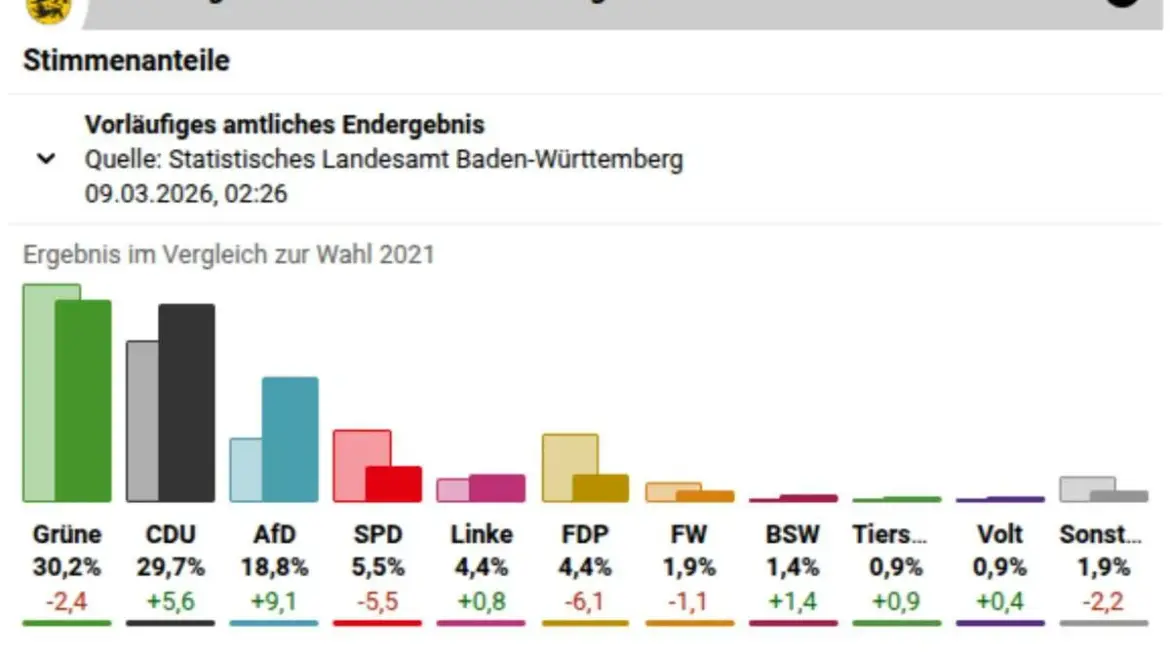
Before the 2026 Baden-Württemberg state election, the political landscape was dominated by established parties, with the AfD being the smallest faction in the state parliament, securing only 9.7% of the vote in the 2021 elections. This positioned the party as a marginal player in a region where traditional parties like the CDU and SPD held significant sway. The expectation was that the AfD would struggle to gain traction, particularly given its classification as a right-wing extremist suspect by the Baden-Württemberg Office for the Protection of the Constitution.
Decisive Changes in the 2026 Election
However, the recent state election on March 8, 2026, marked a turning point for the AfD. The party achieved a preliminary election result of 18.8%, a notable increase of 9.1 percentage points from the previous election. This surge in support has positioned the AfD as the likely largest opposition party in the Baden-Württemberg state parliament, reflecting a significant shift in voter sentiment.
Markus Frohnmaier’s Candidacy
Markus Frohnmaier, a prominent figure within the AfD and a Bundestag member since 2017, was the party’s candidate for Ministerpräsident. At just 34 years old, Frohnmaier has been a close associate of AfD leader Alice Weidel and has been vocal about the party’s conservative values, stating, “Die AfD ist eine bürgerlich-konservative Partei.” However, despite his candidacy, Frohnmaier faces a critical hurdle: he is not on the ballot for the 7.7 million eligible voters in Baden-Württemberg, which effectively eliminates his chances of being elected.
Immediate Effects on the AfD and Its Leadership
The immediate effects of the election results have been profound for the AfD. The party’s increased support indicates a growing acceptance among voters, which could embolden its leadership and influence in the state parliament. Alice Weidel expressed satisfaction with the results, stating, “Das läuft auf eine Verdopplung unseres Ergebnisses hinaus, und damit können wir sehr zufrieden sein.” This sentiment reflects a sense of optimism within the party, despite the challenges Frohnmaier faces.
Reactions from Political Opponents
Political opponents, such as CDU candidate Manuel Hagel, have responded to the AfD’s gains with caution. Hagel remarked, “Für mich ist kein Amt der Welt so wichtig, dass ich mich mit Stimmen der AfD dort hineinwählen lasse,” indicating a reluctance to engage with the AfD despite its electoral success. This highlights the ongoing tensions and divisions within Baden-Württemberg’s political landscape.
Expert Perspectives on the Shift
Experts have noted that the AfD’s rise in Baden-Württemberg could signify a broader trend of increasing support for right-wing parties across Germany. The party’s previous best result in West Germany was 18.4%, and the recent election results suggest that the AfD may be capitalizing on voter dissatisfaction with traditional parties. Frohnmaier’s controversial background, including alleged ties to Russia and right-wing groups, adds another layer of complexity to his political narrative.
Looking Ahead
As the AfD prepares to take on its role as the largest opposition party, the implications of this shift will be closely monitored. Frohnmaier’s future in politics remains uncertain, particularly given his exclusion from the ballot. Nonetheless, the AfD’s electoral gains signal a potential reconfiguration of political alliances and strategies in Baden-Württemberg, with the party poised to play a more significant role in the state’s governance.