Political Landscape Before the 2026 Election
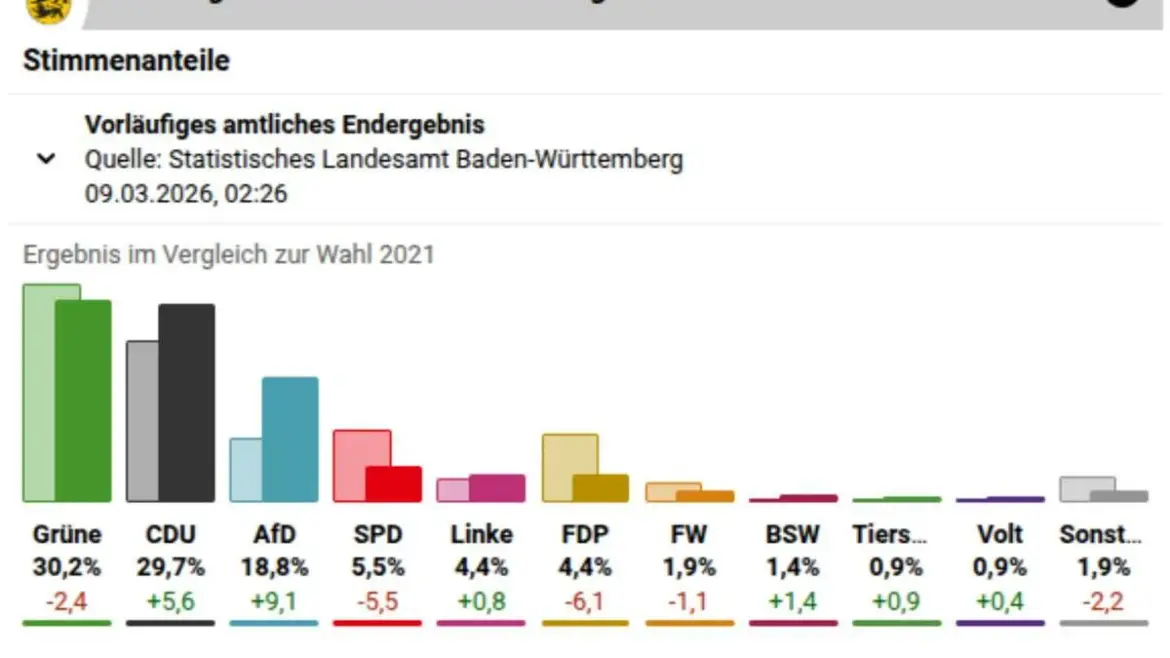
Before the recent developments, the political landscape in Baden-Württemberg was characterized by a steady dominance of traditional parties. The Alternative for Germany (AfD) had been struggling to gain significant traction, with its previous election results showing only 9.7% of the votes in 2021. This left the party on the fringes of political influence in a region known for its centrist and left-leaning tendencies. The expectation was that the AfD would continue to face challenges in breaking through the established political barriers.
Decisive Moment in the 2026 Election
The situation shifted dramatically during the 2026 Baden-Württemberg election held on March 8, where the AfD achieved a notable 18.8% of the votes, marking a 9.1% increase from the previous election. This surge in support was unexpected and indicated a growing acceptance of the party among voters. However, despite being the AfD’s candidate for Ministerpräsident, Markus Frohnmaier could not be elected as he was not on the ballot for the 7.7 million eligible voters.
Immediate Effects on the AfD and Its Leadership
The immediate effects of this electoral performance were significant for the AfD and its leadership. Alice Weidel, a prominent figure within the party, expressed satisfaction with the results, stating, “Das läuft auf eine Verdopplung unseres Ergebnisses hinaus, und damit können wir sehr zufrieden sein.” This sentiment reflects a sense of accomplishment within the party, as they are likely to become the largest opposition party in the Baden-Württemberg parliament. Frohnmaier’s role as a Bundestag member since 2017 and his position as the deputy chairman and foreign policy spokesperson for the AfD faction have positioned him as a key player in this new political landscape.
Frohnmaier’s Background and Controversies
Markus Frohnmaier’s background adds another layer to his political narrative. Born in Romania and adopted by a German couple, he has risen to prominence within the AfD, even co-founding the now-dissolved youth organization Junge Alternative. However, his political journey is not without controversy; he has faced accusations of nepotism regarding his wife’s employment. Additionally, Frohnmaier’s connections to Russia have raised eyebrows, with some describing him as having ‘Russia proximity’.
Reactions from Political Opponents
The rise of the AfD and Frohnmaier’s candidacy have not gone unnoticed by political opponents. Manuel Hagel from the CDU stated, “Für mich ist kein Amt der Welt so wichtig, dass ich mich mit Stimmen der AfD dort hineinwählen lasse,” indicating a reluctance to collaborate with the AfD. Cem Özdemir also weighed in, asserting that the government’s mandate should focus on diminishing the AfD’s influence in future elections, saying, “Was die AfD angeht, ist für mich völlig klar: Der Auftrag des Regierens ist, alles dafür zu tun, dass die AfD beim nächsten Mal schwächer ist.” This highlights the contentious atmosphere surrounding the AfD’s rise in Baden-Württemberg politics.
Expert Perspectives on the Shift
Experts have noted that the AfD’s increased support reflects broader trends in German politics, where traditional parties are facing challenges from right-wing movements. The classification of the AfD as a right-wing extremist suspect by the Baden-Württemberg Office for the Protection of the Constitution adds a layer of complexity to its growing influence. As the AfD positions itself as a ‘bürgerlich-konservative Partei’, Frohnmaier’s assertion, “Die AfD ist eine bürgerlich-konservative Partei. Vielleicht schaffen wir’s ja auch irgendwann mal auf ‘nen Espresso,'” suggests an attempt to rebrand the party for a broader audience.
Looking Ahead
As the political landscape continues to evolve, the implications of the AfD’s performance in the 2026 election will be closely monitored. The party’s rise to potentially becoming the largest opposition force in the Baden-Württemberg parliament signals a shift that could reshape future political dynamics. While Frohnmaier’s candidacy may have faced obstacles, the electoral results indicate a growing acceptance of the AfD among voters, setting the stage for future political contests in the region. Details remain unconfirmed regarding the long-term effects of this shift on the political fabric of Baden-Württemberg.