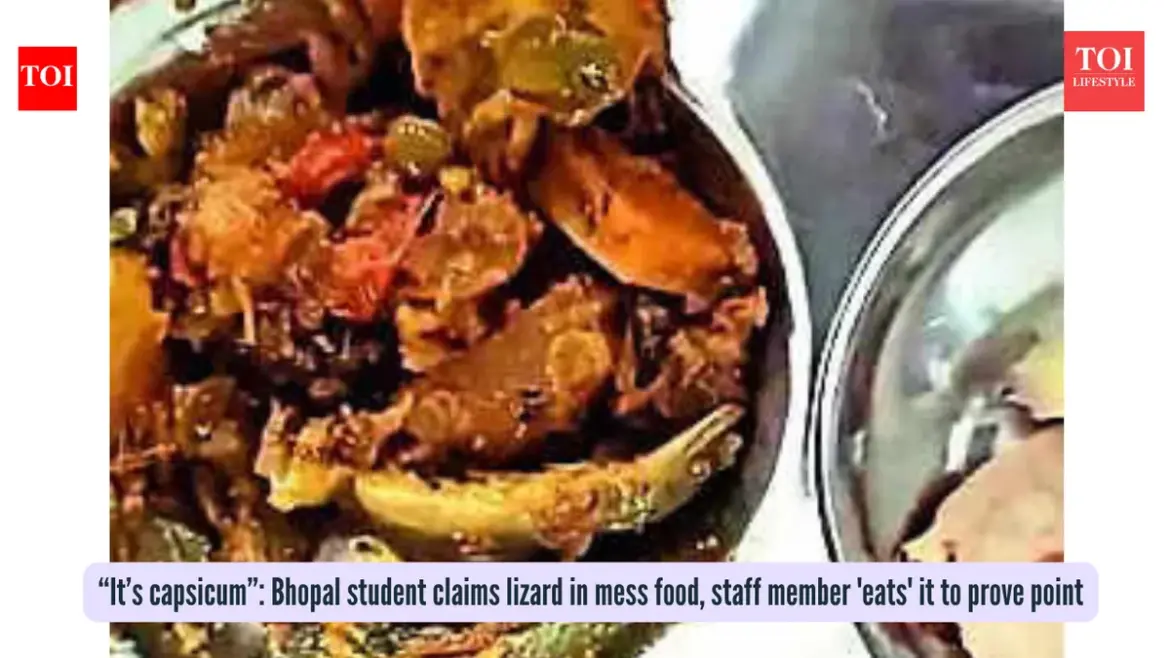
Hostel food often becomes a topic of debate regarding hygiene, trust, and accountability. Recently, a student at the University Institute of Technology, RGPV, in Bhopal, India, claimed to have found a lizard in his meal, igniting a firestorm of reactions and concerns among students and staff alike.
The incident unfolded when the student questioned the unusual object in his food, asserting it resembled a lizard. In a video that quickly went viral on social media, the student exclaimed, “Bhai saab, yeh kya hai, dekh lo,” expressing his disbelief and disgust.
In a surprising turn of events, a mess staff member insisted that the object was merely capsicum, referring to it as “Shimla mirch hai yaar.” To further support his claim, the staff member even consumed the object in front of onlookers, a defense strategy that has drawn both laughter and criticism.
The student, however, remained adamant, stating, “Yeh pahu hai iske. Chipkali hai, uski aankh nikal rahi thi,” indicating that he believed the object had a lizard’s eye. This stark disagreement between the student and the staff has raised serious questions about food safety and hygiene standards in the university’s mess.
In response to the uproar, RGPV Director Sudhir Bhadoria assured the public that student health would not be compromised. He emphasized that the university takes such allegations seriously and has formed a committee to investigate the matter thoroughly.
The canteen operator has denied the allegations, maintaining that the item in question was indeed capsicum. However, the conflicting accounts have left many students unsettled and questioning the quality of food served in the hostel.
As the investigation unfolds, observers are keenly watching how the university will address the concerns raised by this incident. Strict action will follow if negligence is found, according to university officials.
Details remain unconfirmed regarding the actual identity of the object found in the meal, leaving the student community in a state of uncertainty and concern.
This incident highlights the ongoing challenges faced by educational institutions in maintaining food safety standards and ensuring the well-being of their students.