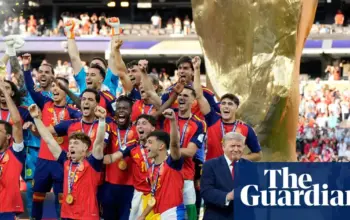
The FIFA 2026 men’s World Cup, hosted across the United States, Canada, and Mexico, has concluded after six weeks of competition. Spain secured their title, defeating Argentina 1-0 in extra-time during the final match held at the New York-New Jersey stadium. This tournament featured a record 48 teams.
The event saw various discussions regarding its organisation and impact. One notable aspect was the “Balogun Affair,” which involved political pressure influencing a player’s participation. This situation, along with Gianni Infantino’s actions concerning qualification criteria for the Club World Cup, has been highlighted as a significant development.
The tournament’s focus on revenue generation was a prominent feature. This approach has led to questions about whether dispensing with established principles for famous players will become an accepted norm. Alternatively, it could strengthen opposition to Infantino, particularly given criticism from British and American politicians.
Ticket prices were another point of contention. While there is a possibility that prices might be lower at the 2030 World Cup, the idea of making a significant portion of tickets available to regular league football fans appears to have diminished. The World Cup is increasingly seen as a luxury event rather than a mass movement.
Host City Impact and Media Relations
The financial and social costs borne by the host cities are expected to become clearer over time. In the US and Canada, there were instances of homeless individuals being displaced, losing possessions, identification, and medication. In Mexico, concerns were raised regarding water extraction and environmental damage linked to World Cup projects.
Media relations during the tournament were also a subject of discussion. Some venues, such as Houston and Atlanta, were noted for their welcoming approach. However, overall basic organisation and facilities for the media were described as being at their worst in at least six World Cups. This was seen as indicative of a broader attitude towards the media, viewing them as an imposition.
One Italian newspaper, la Gazzetta dello Sport, described the World Cup as a “disaster,” citing issues such as ticket prices, the Balogun situation, weather conditions, an increase in games, and reduced rest periods. Following this report, the newspaper’s ticket allocation for the final was reportedly reduced from five to two, raising questions about potential links between critical reporting and access.
On-Field Action and Tournament Assessment
The football itself was described as good, though not exceptional. Several dramatic matches took place, primarily in the last 32 or last 16 stages. These included games like Brazil against Japan, Morocco versus the Netherlands, and England against Mexico. The quarter-finals, however, were not considered particularly inspiring.
Argentina‘s semi-final victory over England was a thrilling encounter, marked by a significant collapse that is expected to be discussed for years. In contrast, Spain‘s win against France in their semi-final was described as relatively straightforward, with Spain quickly establishing superiority that went largely unchallenged.
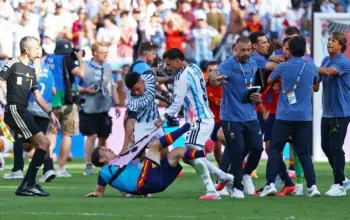
The final match, where Spain defeated Argentina 1-0 in extra-time, was characterised as a dismal affair. The outcome, with Spain winning in their customary manner, was seen as a direct consequence of earlier indulgences shown to Argentina in the tournament. The conclusion of the FIFA 2026 men’s World Cup saw Spain crowned champions.
Source: theguardian.com