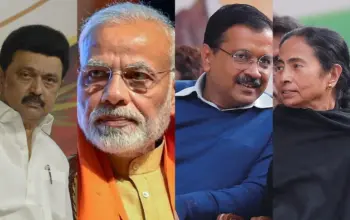
The 2026 elections in India have seen significant upsets, with the BJP poised to take control in West Bengal and a debut party led by a film star making waves in Tamil Nadu. Prior expectations suggested that the Trinamool Congress would continue its dominance in West Bengal, while the ruling DMK was anticipated to maintain its hold in Tamil Nadu.
However, recent developments have shifted the political landscape dramatically. The BJP is headed for a landslide victory in the West Bengal Assembly Elections, having secured 72 seats out of 293 total assembly seats, compared to just 29 seats for the Trinamool Congress. Polling was conducted in two phases on April 23 and April 29, with a record voter turnout of approximately 92 percent.
In Tamil Nadu, actor-turned-politician Vijay’s party, TVK, is poised to deliver a strong performance on its debut, winning 65 seats and leading on another 43 seats out of 234 total constituencies. This marks a notable shift from expectations that heavily favored the DMK.
The direct effects of these results are profound for the parties involved. The BJP is forming its first government in West Bengal since Independence after 15 years of TMC rule. Conversely, the DMK’s performance has been relatively lackluster compared to earlier projections.
In Kerala, where the United Democratic Front has swept the polls with 99 seats, it appears that traditional voting patterns continue to hold firm. Meanwhile, in Assam, the BJP has bagged 73 seats out of 101 declared constituencies, further solidifying its position across various states.
The National Democratic Alliance is also set to form the next government in Puducherry with a majority of 18 seats in the 30-member House. These results indicate a broader trend of consolidation for the BJP and its allies across multiple states.
This shift has drawn attention from political analysts who suggest that these results could signify changing voter sentiments across India. The political dynamics are evolving rapidly; as such, understanding these trends will be crucial as parties strategize for future electoral battles.